|
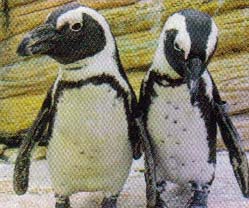
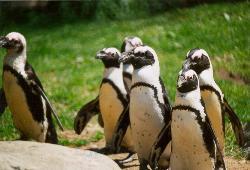
Penguins Appetite for Change HarmfulDENVER- At the Denver zoo, the penguins' diet is proving too rich for their own good. Zookeepers are hoping for change. In fact, they've found 71 coins in the stomach of a particularly hungry penguin. Visitors have been tossing coins into the zoo ponds, believing they arev wishing wells. But two of those ponds are home to 26 penguins that believe the coins are the shiny scales of tasty fish. The penguins- 13 Humboldts and 13 Africans- are eating the coins, which can cause fatal zic-poisoning once digestion starts, zoo officials said Thursday. Pennies made after 1978, which have zinc cores with copper coatings, are especially bad for the penguins. Pennies made before 1978 are pure copper. Veterinarians have been busy removing the coins surgically. They use an endoscope with a small net attached to it to scoop the coins out of the penguins' stomachs. The endoscope also has a camera and a light at the end to help the doctors find the coins. Penguins swallow coins so frequently that zookeepers now routinely run the birds through metal detectors looking for ingested coins. "This is a common problem for the penguins," said veterinarian Dr. Felicia Knightly. "Penguins cannot tell the difference between the the shiny metallic coins on the bottom and fish," Knightly said. |
|
|
|
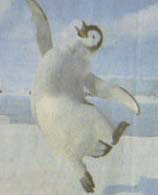
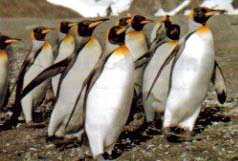
"Happy Feet" puts renewed spotlight on penguinsIf you're ready for a toe-tappin', foot-stompin', knee-slappin', finger-snappin', hand-clappin' good time, waddle on down to the movie theater to see Happy Feet, sort of a snazzier and happier animated version of March of the Penguins. The Emperor Penguins of the Antarctic are the stars of Happy Feet, a movie that- with plenty of tap dancing sequences and cool penguin names like Mumbles and Memphis and Norma Jean- will get you into an anthropomorphic mood. But where, besides a movie theater, can you find these black-tuxedoed birds? Not anywhere north of the Equator, for starters, except in a zoo. They are not in places like the Arctic or Alaska or even Greenland or Iceland or Siberia, all perfectly fine, cold places where you would normally think penguins would hang out. Nope, they're only found near the chilliest of oceans in the Southern Hemisphere. There are 18 species of penguins around the globe, with seven of those species living in the Antarctic, including the Emperor penguin as well as the Adelie, Gentoo and Chinstrap. If Antarctica is just a little too far south and the air just a bit too frosty, then consider South Africa. With direct flights from the United States, South Africa is perhaps the easiest place to get to for seeing penguins. African penguins, like humans, enjoy warm weather in addition to their cold ocean. Boulders Beach, a series of hidden sea coves near Simon's Town on the eastern coast of the Cape Peninsula, and Stoney Point in Betty's bay on the Western Cape are two of the best locations to find them. Others live in the coastal regions of Namibia, which borders South Africa to the north. Penguins Down UnderMore penguin tourism awaits in Australia, where the "Penguin Parade", one of the continent's best known wild-life attractions, is on Philip Island, just outside of Melbourne. This just happens to be the world's largest colony of Little Penguins, with numbers approaching 26,000. Philip Island, just 16 miles long and fewer than 5 miles wide, is also a year-round home to a variety of other species of wildlife, including koalas, seals and hundreds of bird species. Another place to see penguins in the wild is in South America, primarily in the Patagonia Region. Humboldt and Rockhopper Penguins live on the coastal shores of Chile and Peru, while the King Penguin is found primarily in Tierra del Fuego, on the very tip of Argentina. Galapagos IslandsThanks to the chilly waters of the Humboldt Current, another place to see penguins is in the Galapagos Islands. Like the Jackass penguins of South Africa, the Galapagos Penguins, which live close to the Equator, prefer warmer water. The Galapagos Islands, like Philip Island, offer incredible wildlife besides penguins, including whales, giant tortoises and the blue-footed booby. The yellow-eyed penguin is the rarest of all. To see it, you must travel to either Tasmania or New Zealand. The yellow-eyed penguin has distinctive yellow eyes highlighted with a bright yellow stripe that runs around the back of its head. You also can find Little and Fiordland Penguins in New Zealand. Where to Find Penguins |
|
|
|
No one involved in Happy Feet set out to make a block-buster tribute to tap-dancing. But as it turned out, the movie about a hyper-rhythmic penguin who saves his flock with his dancing feet is the best thing to happen to tap since Fred Astaire. Perhaps it's better. Astaire was big, Astaire was a genius, Astaire was Astaire- but he was no darling, fuzzy little bird, nor the object of pint-size wuv. The misfit penguin Mumble, on the other hand, is all these things and one of the biggest stars at the box office. The flightless fowl is sure to be seen by zillions of kids and parents around the globe. For fans of rap, humble Mumble is the new messiah. It's not such a crazy notion. At first blush, Happy Feet may seem to be just another computer-generated kid flick, like Shrek or Toy Story. But in skillfully merging art and entertainment, it sets a new 21st-century standard for the movie musical. Like the great pictures of the '30s, '40s, and '50s that showcased the talents of Astaire and Ginger Rogers, Gene Kelly, Judy Garland and their ilk, Happy Feet tells a good part of its story through the music of its day, incorporating rap, funk, disco, rock and Latin tracks. A few grand multi-penguin production numbers, featuring singing and dancing, flesh out the main characters, mark key emotional segments and move the plot along. But what makes Happy Feet both a throwback to Hollywood's golden era and a product of the digital age is this: It relies on real, live talent for the dancing. For it's not mere pixels that make Mumble move; it's Savion Glover, the onetime whiz kid of tap, who, at 33,is the highest-profile solo artist in the business. Motion-capture technology was used to transfer Glover's performances in a specially equipped studio onto an animated character on-screen. "I knew even the greatest animators in the world would take a lifetime to pull off the nuances of dancing that a gifted dancer is able to pull off," says Happy Feet director George Miller. Admittedly, The Austalian filmmaker is a bit of an odd choice to take up the mantle of Vincent Minnelli and Bob Fosse. He was first a doctor, then a director; he previously helmed in the three Mad Max movies, Lorenzo's Oil and Babe: Pig in the City (sequel to the first Babe film, on which Miller was a writer) "I never, ever thought, until Happy Feet, that I'd work on a musical," Miller says. But music became imperative to his concept of a penguin drama. Miller says he had long been intrigued by the Antarctic's Emperor Penguins- well before last year's documentary March of the Penguins came out, as Happy Feet was four years in production- and by the fact that in their close-knit communities each bird is identified by a signature squawk. Miller envisioned a colony of penguins not squawking but singing, courting their mates with the power of their innate "heartsongs." And what if one hatchling couldn't carry a tune? Maybe he could make music...with his feet. In other words, tap dance. "It's the closest thing to singing with the body that you could do," said Miller. "And I just had this thing about tap-dancing." That "thing" developed some time ago when, while working on another project, a crew member's wife taught Miller a bit of tap-dancing for a cast party. "I had quite a bit of alcohol," he recalls with a laugh. When he knew his film would focus on a tap-dancing penguin, Miller said, he studied the classic movie musicals, drawing on Gene Kelly's finesse, the pacing of West Side Story and even the kaleidoscopic patterns of Esther Williams' films, for the penguins' underwater sequences. Next logical step: Bringing aboard Glover- whom Miller calls "without question the greatest living tap-dancer." It's a difficult point to argue, with his Broadway successes (including Bring in 'da Noise, Bring in 'da Funk, in which he starred and won a Tony for best choreography) and heavily attended one-man shows. The hoofer is a true percussionist, with a heavy-hitting, powerful style that directs all attention to the beat- no flash, little upper-body movement, just two feet drumming out a force field of sound. For Miller, Glover's ultra-contemporary style was a perfect way to amplify Mumble's character. For Mumble stands apart for other reasons besides being tone-deaf. He's blue-eyed and irrepressibly bubbly (brightly voiced by Elijah Wood). The scorn of his elders doesn't get him down. And when he finds that his flock's dwindling food supply is due to "aliens"- humans who are polluting and overfishing their waters- he sets out to stop them. On a certain level, this is so like a tap-dancer. Akin to a jazz improviser, a geat hoofer doesn't follow set steps. Being out of step, in fact, is his strength. He goes his own way, he refuses to conform. His rhythm is intuitive, and with it he generates his own joy. The film has many messages, including environmentalism, the struggle between dogma and daring, and the value of questioning authority. But none of these points were what drew Glover to the production. In fact he says he knew next to nothing about the plot- nor that stars such as Robin Williams, Nicole Kidman and Hugh Jackman were lending their voices- until he attended the premiere. The movie's success has been a big surprise. When Miller first approached him about the tap-dancing penguin idea, "I was just so excited that someone was putting dance in the movie," Glover said. "I didn't ask any questions. I was just going on the strength of tap-dancing- someone wants tap-dancing." Once he flew to Australia, he was fitted with a skintight suit suit covered with small reflectors. Cameras then captured the motion of the reflectors as Glover danced, and technicians applied the data to the image of Mumble. The result could be seen instantly- instead of looking at his reflection in a mirror, the way a dancer might practice in a studio, Glover faced a computer screen as he danced, which showed what he looked like as Mumble. Miller, also peering into a monitor, could speak to Glover through a headset to keep his performance in line with a penguin's range of motion. For instance, Glover needed to starighten his posture- in his own performances, he tends to look down, focusing on his feet, and "that just wasn't a good look for the penguin," the dancer says. Despite the upright stance, for followers of tap, the penguin's footwork is unmistakably Glover. Miller loves the idea that Mumble's "stunt double" is clear to the discerning eye. "People say that pretty soon we can make (computer-generated) actors, but the truth of the matter is you can't deny that life-force in people," he says. "You can feel Savion very clearly in penguin." For his part, Glover feels Miller has done tap a major favor, sparking "a resurgence in the dance, to really help us maintain a presence." |
|
|
And the Winner is . . . Pudge! |
|
|
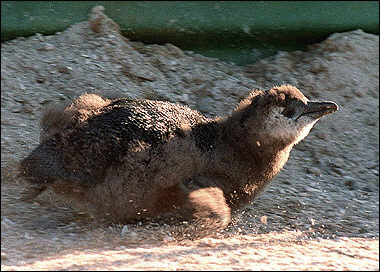
It's a Boy!!!Detroit Zoo contest gives until July 31 to christen new arrivalOne mystery was put to rest- it's a boy. The Detroit Zoo announced Wednesday that its 51-day-old Macaroni penguin is a male. However one more mystery remains unsolved- what will his name be? People have until July 31 to participate in the Name the Chick Contest, in which they can submit suggested names for the baby penguin. The prize is a "Mingle with the Macaronis", which includes the opportunity for the winner and three guests to interact with the baby penguin and the zoo's 62 other penguins in their habitat, feed the birds, receive a tour of the keeper area and take photos. The penguin, which weighs nearly 7 pounds, will look remarkably different when it matures. The sooty fur with a milky white belly will be shed within 3 weeks, replaced by glossy black feathers, and it will have to wait a year to earn its characteristic golden crown. Now, shaped like a bowling pin with faded pink webbed feet, he is a far cry from his mother, Nibbles. He is the first baby penguin born at the zoo in 2 years. The baby penguin appeared to relish the opportunity as he was introduced to the media Wednesday, flailing his wings hurriedly and craning his head, turning to allow photographers to see every angle. Bonnie Van Dam, associate curator of birds, said the penguin's actions were not uncommon. "Youngsters have a tendency to hop around and flap their wings a lot, " she said. She also noted that wing-flapping is a mechanism used by penguins to cool off, and that the high-pitched squawk he emitted would deepen with time. The penguin's public introduction attracted many visitors, including 9-year-old Daphne Logan of Bloomfield Hills. We "came to enter the contest and to see the baby penguin," she said. "It's kind of unusual, but " I want to name him "Noodles because he is a Macaroni penguin." |
|
|
|
Penguin News from NorwayOslo, Norway: Eight penguins became the first birds in Norway vaccinated against bird flu Friday after an aquarium won an eight-month battle with health authorities, a newspaper reported. "The safest birds in the Nordic region," declared a headline in Bergen's Tidende newspaper. The paper said the birds were among the first in northern Europe to get the vaccine. The Bergen Aquarium in western Norway's main city, had been trying to get government authorization for the vaccinations. The Norwegian Food Protection Authority, which must approve such cases, refused because no outbreaks of the deadly H5N1 strain have been found in Norway and it frowns on overuse of vaccines. On Friday, the authority relented and granted approval. But after two of the eight birds were vaccinated, it withdrew the permit, only to give the final go-ahead a few hours later. |
|
|
|
Stolen chick's penguins become parents againLONDON- The penguins who had their chick stolen just before Christmas have hatched another egg at a zoo in southern England, officials said Saturday. Kyala and Oscar's new chick was born Tuesday, but has yet to be named and its gender was not yet known, zoo owner Derek Curtis told reporters. Three-month-old Toga disappeared mid-December from the Amazon World zoo on the Isle of Wight, off the south coast. The bird has not been found and is presumed dead, as experts said it was too young to survive without its parents. |
|
|
RoboticsMimicking the March of the Penguins |
|
|
|
Penguins are more than just the cuddly stars of wintertime ads and documentaries. The tuxedoed birds may help unlock the mysteries of two-legged motion and could help robots learn to balance better. Thanks to an innate ability to adjust for their squat build, penguins can waddle for miles without toppling over. The key is a side-to-side rocking motion that carries them forward efficiently, if inelegantly. Such movements are tricky for humans because our brains do a bad job adjusting for drastic sideways motions. Now, the University of Houston's Max Kurtz hopes to adapt the birds' unique gait to robots. The professor of health and human performance tracks the width and length of the penguins' steps as they traverse a pressure-sensitive mat. The data could improve the march of future bots by replacing cumbersome motion-control equipment with computers that guide more natural forward movement. |
|
|
Update on Toga's parents |
|
|
|
Last month, a baby penguin named Toga was stolen from a zoo on the Isle of Wight, off England's southern coast. Despite a reward of more than $40,000, Toga is still missing. But in the meantime, Toga's parents, Oscar and Kyala, have produced a new egg. According to zoo owner Derek Curtis, their mood has also improved. "Kyala was absolutely stressed for the first two weeks, wandering up and down," Curtis said. "Then they started to beak-tap and then they started carrying nesting material, which we were quite happy about." Kyala laid the egg last week. "Within 40 days," Curtis said,"we should have another Toga in our life." |
|
|
Missing Penguin's mom lays a new egg at the Zoo-London- The parents of Toga- the infant penguin whose disappearance last month was followed around the world- have produced a new egg, zookeepers said Monday. Toga, a 3-month old jackass penguin, disappeared from Amazon World, on the Isle of Wight in southern England. Despite scores of reported sightings and an on-air confession from a man who called a TV station to admit to stealing the bird, Toga has not been found. Zoo manager Kath Bright said staff discovered last week that Toga's parents had laid a new egg. |
|
|
Outlook grim for Toga, the stolen penguin- Police said Thursday they feared the worst for a baby penguin whose plight has prompted headlines around the world after he was stolen from a British zoo five days ago. Toga, a three-month-old Jackass penguin, was snatched on Saturday night from the Amazon World zoo on the Isle of Wight, off the south coast of England. Zoo managers think he might have been stolen as a Christmas present by thieves inspired by the hit documentary film "March of the Penguins." But they warned that unless the brown and white colored Toga was swiftly returned, he would die. Pictures of his crestfallen parents were splashed across the front pages of newspapers in Britain and the tale has tweaked the heartstrings of animal lovers globally. "It's absolutely unbelievable. We've had so many e-mails and well-wishes from people around the world, it's just stunning," zoo manager Kath Bright told Reuters, saying messages had come from as far afield as the U.S., Australia and South Africa. Media reports said congregations at two churches in America were even praying for Toga, who is said to be very vocal, with a voice like a donkey braying. "It gives you renewed faith in the human race," Bright said. She added the zoo was currently on tenterhooks after an anonymous man called to say he had dumped Toga Tuesday in a plastic bag at Portsmouth docks on the English mainland across from the island. A rescue team is now on standby to rush out if the report is true and Toga is found. However Hampshire police who have been investigating the theft said the report had not made them very hopeful that Toga was still alive. "I think it's really sad," said a police spokeswoman. "I don't envisage a happy ending." |
|
|
|
Reward offered for stolen penguinToga's plight has moved local people A reward is being offered for the return of a Jackass penguin chick stolen from a zoo. Toga, who has the brown and white colouring of a juvenile, was taken from Amazon World between Newport and Sandown, Isle of Wight. The zoo offered �1,000, with �2,000 more coming from donations, the Times newspaper reported. The penguin's mother is said to be pining for him, and the animal is expected to perish soon. The animal needs its mother as it will not take food from humans. Born in September, Toga lives on a special diet and needs to be kept cool, with access to plenty of fresh water. Toga was the first South African Jackass Penguin to be bred at the island zoo. Including his parents, there are now only six adults left. There are about 150-200 of the rare and endangered breed in the UK. It is thought the thieves climbed over a six-foot outer wall before clambering over an eight-foot metal and concrete barrier. Zoo staff believe the popularity of the film March of the Penguins may have inspired the crime. |
|
|
Penguin SeenIt has been reported that Toga, the lost penguin has been sighted in Portsmouth Harbour. The BBC reports that a member of the public has reported dumping the penguin in Portsmouth and that the Police and representatives from Amazon World are investigating. Reward Offered for Return of Penguin A reward of �1500 has been offered for the safe return of a baby penguin taken from Amazon World on the Isle of Wight. �Toga� is a 3-month old Black Foot penguin and was born at Amazon World. It is feared that if the baby penguin is not found soon he perish as he will not take any food from humans. The Parents of Toga, Kyala and Oscar are pining for their offspring and check the nests several times a day in search of him. If anyone has any information please contact Amazon World or the Hampshire Constabulary. |
|
|
A young penguin believed to have been stolen from Amazon World at Sandown has police and staff at the attraction worried that it might not survive. Toga the Jackass Penguin disappeared during Saturday night and it is feared that if he is not found quickly, he will die. The brown and white penguin, born in September and still being fed by his mother when he was stolen, needs special care and is not old enough to leave his parents. Police said he will not feed from a human and will be very stressed. He could also bite when frightened. Toga is said to be veery vocal, making a noise like a braying donkey. He needs a special diet with supplements and has to be kept cool, with access to plenty of fresh water. Amazon World manager Karen Bright said: "Someone must know of his whereabouts and our main priority is to have the baby returned as soon as possible." Anyone with information can contact Amazon World on 867122 for staff to collect him, or call police on 0845 045 4545 or the anonymous Crimestoppers number, 0800 555 111. 19 December 2005 |
|
|
note from cam: i'd been putting off entering the news stories about Toga, the kidnapped penguin, hoping good news would arrive, but so far, no....:( it was so depressing over the holidays to have a sad family story about our fav bird, even as my house is all decorated with Christmas penguins, and looks VERY happy!.....so i couldn't bear to print the stories right away.... there will probably never be a wrap-up of it, either.... |
|
|
|
They weren't marching across 70 miles of frozen tundra in the Antarctic -- only across 70 feet or so of fuzzy red carpet at the Monterey Bay Aquarium But two black-footed penguins -- Patience and Seekoei -- put on quite a show Thursday. And it was just a rehearsal. "Meet the Penguins" will be playing for real starting Monday. After opening with that red-carpet entrance, the performance will feature plenty of comedy, information and audience interaction. Two kids will even get "up close and penguinal" with a chance to touch the birds on the back. And while their entrance is worthy of Elvis, at the end the stars will not leave the building. Between performances, they'll just chill out at home in the Splash Zone upstairs. Or, more precisely, up-elevator. This is the first time, since it started in 2001, that the program involves penguins riding between the second floor and the first, said Karen Jeffries, the aquarium's assistant public relations manager. "There was some hesitation at first for them to go in and out," said curator Christina Slager, producer, director and one of the human co-stars of the extravaganza -- along with senior aquarist Julia Mariottini and education specialist Dan Weinstein. "But by session four or five they were over that." Slager was referring to the weekly practice sessions the performing penguins have year-round. "Otherwise the training goes (on)," she said. And training a penguin is not like training, say, a dog, who will do just about anything for food. Penguins can go a month without eating, so enticing them with goodies -- even special faves such as nice smelly smelts -- will get you nowhere, at least not very fast. Fortunately, penguins are a soft touch for a soft touch. "We simulate preening," Slager said. "Around the neck, under the chin, is best, someplace they can't reach themselves." The technique seems to work wonders. Patience and Seekoei and their two understudies can hardly wait to strut their stuff. "They come right to the door," Slager said. "It's like they're saying 'Pick me. Pick me.'" At least, it looks like that's what they would be saying if they were people. But Slager doesn't like to attribute human feelings or motivations to penguins, even though it's so tempting, what with their humanlike posture, to say nothing of their tuxedolike clothes, er, coloring. The elevator ride isn't the only first for this year's show. This is also the first time that "Meet the Penguins" isn't just "Meet the Penguin." The first time, too, that one of the stars has come all the way from New Orleans. Patience is one of 19 penguins -- 16 black-footed and three rockhopper -- that were rescued from the Audubon Aquarium of the Americas after Hurricane Katrina shut it down. "She trained up really quickly," Slager said. "But then we had a pre-existing relationship." She has known the 24-year-old penguin since the bird was a year old. They were giving shows together in the 1980s. At 7, Seekoei is more of a spring chicken, and he has a tad more spring in his step. "So Patience gets a little head start out of the elevator," Slager said. But Patience is still in great shape and not really a senior citizen. Not for black-footed penguins in aquariums and zoos, at least. In the wild, they usually don't live more than 18 years. But the record in captivity is 34 years. "It's all the food you can eat, free medical and no predators," Slager said. "It's like living at the spa." |
|
|
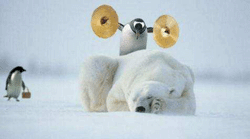
The ©Coca-Cola Company has launched its Christmas 2005 advertising campaign, supported by a strange geographical manipulation that allows the well-known (and loved) Polar Bears to be joined by the Coca-Cola Penguins. But as the old schoolboy joke goes: "What's the difference between a polar bear and a penguin? About 12,000 miles" (and never the twain should meet). But forgiving the unusual sight of the polar bears and penguins together, the campaign promises to be as successful as its predecessors, also heavily featuring Santa (as originally painted by Sundblom in the early 20th century). The new catch-phrase is "Give. Live. Love. Coke." Led by the polar bears, the entire family of Coca-Cola holiday characters will be featured in this year's campaign, on packaging, advertising, and point-of-sale displays. Finally, the Coca-Cola Holiday Caravan (trucks, actually) emblazoned with thousands of lights and Santa's grinning image will visit communities across the USA to signal the arrival of the holiday season. |

|
-- Move over elves. Thanks to Coca-Cola, Santa now has some new helpers to spread the holiday spirit this year. To help celebrate the holidays this year, the popular ©Coca-Cola Polar Bears and the familiar Sundblom Santa are joined by a festive group of penguins. "©Coca-Cola holiday packaging and commercials have become a tradition that families anticipate each year," said Katie Bayne, senior vice president, ©Coca- Cola Brands, Coca-Cola North America. "Our special holiday message of Give. Live. Love. Coke. reminds people to come together and share the magic of the season and the spirit of generosity, just as our Polar Bears, penguins and Santa do." This week the Coca-Cola penguins make their debut when they join the Coca- Cola Polar Bears at the North Pole in the new spot entitled "Arctic Beach Party." In the ad, the bear family is awoken by the sounds of a party accompanied by the Beach Boys tune "Little Saint Nick." While investigating the noise, the polar bear cub slips down a hill into a group of dancing penguins. As the penguins and bears eye one another, a small penguin appears and offers the cub a bottle of Coca-Cola, signaling the bears to join the holiday celebration. **note from camarila: when i first saw this delightful ad at our visit to see Harry Potter and the Goblet of Fire, i told the children with me "That would NEVER happen in real life, and do you know why?"...."Because the polar bears would EAT the penguins," they responded, and as i tried to lecture on northern and southern hemispheres, their eyes glazed over, and Harry started!! lol |
|
|
Penguins: Mankind's new role model |
|
|
Conservatives have found an unlikely new "battle anthem in the culture wars," said Jonathon Miller in The New York Times.The hit documentary March of the Penguins, about the breeding rituals of emperor penguins in the Antarctic, is drawing Christian conservatives into theaters like no movie since The Passion of the Christ. The film follows a group of flightless birds resolutely waddling 70 miles across the frozen wastes to their breeding ground, where, in inseparable male-female pairs, they huddle to provide warmth and protection for their eggs. It's a powerful lesson in monogamy, family values, and the nobility of self-sacrifice, said Jill Stanek in Worldnetdaily.com, with nearly every scene verifying "the beauty of life and the rightness of protecting it." I only hope that "lusting, self-centered males" and "militant females" see it, too. Male penguins, they'll note, don't run out on their families to chase new tail, and the women don't abort their babies because it's inconvenient to raise them. "Sometimes, I wish humans would behave more like animals." Are we talking about the same film? asked Lenore Skenazy in the New York Daily News. Far from being paragons of monogamy, emperor penguins mate for one year- and then move onto a new man the following year. Worse, the females behave suspiciously like feminists, laying their eggs and leaving them with "this year's boyfriend" as they head off for months to hunt for food. The males, meanwhile huddle together like men in a crowded disco, with the snow swirling romantically around them. "This isn't a conservative utopia. It's Studio 54 on ice." No joke- some penguins really are gay, said The New York Times in an editorial. Only last year we broke the story of Roy and Silo, the two male chinstrap penguins at the Central Park Zoo who pair bonded and adopted a chick together. "If emperor penguins are sending us a message about heterosexual marriage, then what are Roy and Silo doing?" You're all missing the point, said John MacDonald in The Arizona Republic. While one cannot help but be moved by the struggle of the black-and-white stars of Penguins, the fact that commentators from either end of the political spectrum have been able to read so much into it should alert us to "the biggest problem facing Americans today": that liberals and conservatives both have far too much time on their hands. Get a life, people. And if you go to this movie, "just watch, keep quiet, and pass the popcorn." |
|
|
|
|
|

|
Blockbusting Penguins Soar up all-time List |
|
|
They're short. They waddle. They can't even leave the ground. But they're the highest-flying birds in Hollywood. |
|
|
Their movie, The March of the Penguins, is the most unusual rags-to-riches story in years. Made for less than $1 million, the film topped $27 million in total revenue after four weeks. It's by far the richest nature documentary ever, and it's #2 on the all-time documentary list, sandwiched between Michael Moore's Bowling for Columbine at #3 and his politically charged Fahrenheit 9/11 on top. "I guess both red and blue states love penguins," said Steven Friedlander, executive vice-president of distribution for Warner Independent, the film's distributor. "It's playing as a family film, as a date movie, to older couples, to young girls." Michael Lowe of Dallas recently persuaded his fiancee to see the show. "I'm secure in my manlihood. Little penguins waddling around? What could be better?" That emotional connection,combined with the film's simplicity and the fact that you can't quite believe you're watching penguins honk and slide on their bellies for 85 minutes, are all part of the appeal, says Paul Dergarabedian, president of the box-office tracker Exhibitor Relations. "By the end of the summer,people get blockbuster fatigue from seeing all the big summer movies," he says. "This is such an unlikely success story. It had a very low budget, it was picked up for a small amount, and it continues to rival the blockbusters in its success." The documentary, originally released in France, was re-engineered after being picked up by Warner Independent and National Geographic at January's Sundance Film Festival. The Babe-esque penguin dialogue was chopped in favor of "homespun, grand-fatherly" narration by Morgan freeman inspired by old Disney nature films, Friedlander says. To stay family-friendly, penguin death scenes are cloaked in oblique terms. For example, as one ill-fated waddler strays from the pack toward the icy horizon, Freeman narrates, "He will simply fade away." Another time, he explains, "Some will fall asleep and disappear." Don't expect Penguins to vanish from movie screens any time soon. It's at #7 on the weekly box-office charts. Last weekend, it topped Fahrenheit as the widest release documentary ever. So will Oscar come calling next winter, as it did for Moore's Bowling for Columbine two years ago? If so, the tuxedoed actors are already dressed for the occasion. |
|
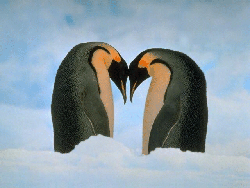
|
(movie review by Emma Trelles, entertainment writer for the South Florida Sun-Sentinel)
The opening sequence of March of the Penguins reveals a miragelike landscape of white and watery blue. In the distance, a winding line of black druidlike figures makes its way across the horizon. It's the first time we see the emperor penguin on its journey through the icy deserts of Antarctica. The penguins will travel for a week straight just to find a mate. Its one of several instances during this remarkable documentary, narrated by ther engaging timbre of Morgan Freeman, that these birds who cannot fly are humanized, as their stories of loss, survival, family and love unfold across one of the bleakest terrains on the planet. |
|
|
|
Filming for 13 months, biologist and first-time director Luc Jacquet and his crew pitched camp in the Antarctic during winter. Their daily presence allowed them to draw closer to the hardy penguins. The story that Jacquet uncovers is one that few have seen, although it, like the central characters, has endured for thousands of years. After a long plod across the ice, the flock arrives at its breeding grounds. The event resembles an enormous downtown happy hour. Some males are trolling in twos with the requisite wingman, as well as plenty of preening and butting of the chests. When all have paired off, the soundtrack soars with flutes. Now the penguins stand forehead to forehead or stare into each other's eyes for heartfelt stretches. Jacquet's obvious reverence for his subject turns the propagation of a species into a grand love story. As the documentary follows the path of the offspring, the story begins to drag. Frames of impossibly cute chicks bump up against those where newborns are picked off by predator birds or frozen in a stiff heap atop the ice. After tracking a number of the penguins' successes and losses, we get it. Harsh place. Survival is not easy. Some make it. Some don't. Still, the repetition is a small flaw when the film offers such exotica. |
|
|
|
|
|
|
February, 2005
source: www.ananova.com/Zoo tempts gay penguins to go straight.A German zoo has imported four female penguins from Sweden in an effort to tempt its gay penguins to go straight. The four Swedish females were dispatched to the Bremerhaven Zoo in Bremen after it was found that three of the zoo's five penguin pairs were homosexual. Keepers at the zoo ordered DNA tests to be carried out on the penguins after they had been mating for years without producing any chicks. It was only then they realised that six of the birds were living in homosexual partnerships. Director Heike Kueck said that the zoo hoped to see some baby penguins in the coming months. She said that the birds had been mating for years and one couple even adopted a stone that they protected like an egg. Kueck said that the project has the support of the European Endangered Species Programme because the penguins, which are native to South America, are an endangered species. A biologist will be on hand to monitor the experiment. But introducing the Bremerhaven penguins to their new Swedish friends may not be as successful as hoped after earlier experiments revealed great difficulties in separating homosexual couples. In case they show no interest, the zoo has also flown in two new male penguins "so that the ladies don't miss out altogether", Kueck added. |
|
|
|
Penguins Resist "Aversion Therapy"But the homosexual penguins were not interested in dallying with the other sex, remaining faithful to their same-sex partners. "The relationships were apparently too strong", said zoo Director Heike Kueck. The gay males were separated from their mates and one by one the females were introduced. The males pined for their mates until they were reunited. |
|
|
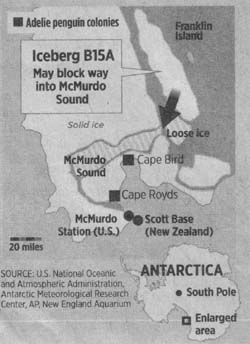
A remnant of the largest iceberg ever recorded is blocking Antarctica's McMurdo Sound, threatening tens of thousands of penguin chicks with starvation and cutting off a supply route for three science stations, a New zealand official said Tuesday. The iceberg, known as B15A, measures about 1,200 square miles, said Lou Sanson, chief executive of the government scientific agency Antarctica New Zealand. He called it "the largest thing on the planet right now" ans said U.S. researchers estimate it contains enough water to supply Egypt's Nile River complex for 80 years. It is so big it has blocked wind and water currents that break up ice floes in McMurdo Sound during the Antarctic summer, which begins later this month. The U.S. McMurdo Station and New zealand's Scott Base are located on the sound. Italy's Terra Nova base is nearby. |
|
|
|
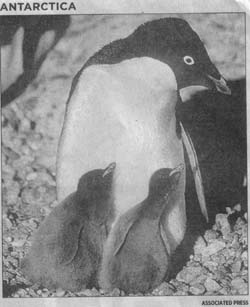
The iceberg is in the path of four ships due to arrive in Antarcica in a month with fuel and food for the three stations. Scientists are looking intosolutions, including breaking an 80-mile path through the ice. While the situation is a growing concern, the bases are not immmediately in danger of running out of supplies, Sanson said. The same cannot be said for the newborn Adelie penguins. Tens of thousands of the chicks could starve in coming weeks because the ice buildup in the sound has cut off their parents' access to waters where they catch their fish, Sanson said. There is more fast (blocked) ice in McMurdo Sound than we've evr recorded in living history for this time of year, Sanson said. The penguins are important to scientists as markers of environmental chance, such as global warming. The iceberg is threatening two of four colonies in the area that scientists have been studying for 25 years. One is on Cape Royds, where 3,000 breeding pairs of Adelie penguins now face a 112-mile round trip to bring food to chicks at their nesting grounds. The parents cannot survive such a long journey without eating much of the food they have gathered for their young, Sanson said. Penguins carry the food for their young in a pouch in their necks and will eat it themselves if they get hungry enough. |
|
 King Penguins |
Study to Assess Penguin Habits |
|
|
Scientists are embarking for the Falkland Islands to try to unravel the mystery of why penguins there seem to topple over whenever a helicopter flies past, British newspapers report. British servicemen stationed in the South Atlantic islands have claimed for years that the penguins are so mesmerized by the helicopters that they lose their balance and fall on their backs as they follow the aircraft's flight path. Researchers from the British Antarctic Survey, based on board the ice patrol ship Endurance, will spend a month observing the behavior of a king penguin colony as helicopters fly overhead, the Daily Telegraph said. Scientist Richard Stone said he believed the phenomenon was nothing more than an urban myth. "Aircraft do have an effect on penguins, but not to the extent of birds falling over," he was quoted as saying by the Telegraph. "The intention of the work is to discover if overflights can harm colonies." |
|
 South African Penguins |
VOLUNTEERS MOBILIZE TO RESCUE PENGUINS |
|
|
The penguins just keep coming. For two weeks- ever since an oil spill off South Africa's coast began threatening tens of thousands of African penguins-the largest bird-rescue operation ever undertaken has churned along. More than 10,000 untainted penguins have been evacuated from their island home off Cape Town's coast, driven eight hours east and released into the ocean for the long swim home.Authorities hope the trip will take them at least 10 days- long enough to break up the spill from a tanker that sank off Cape Town on June 23. Meanwhile, oil-soaked penguins have arrived by the truckload at a warehouse-turned-bird refugee center. By Friday, more than 18,000 traumatized birds had been brought to the warehouse and 4,000 more were being housed in other rehabilitation centers in the city. The numbers are expected to climb. "To see the birds in this state is absolutely shocking," said volunteer Craig Viljoen."The birds are suffering and time is starting to take its toll on them." The warehouse is abuzz with activity. Volunteers of all ages don bright yellow oilskins and pitch in to care for the birds, which must be watched over for up to two months until their coats have regained the waterproofing destroyed by the oil. "The response has been incredible. We've had people from all over the world coming in to help," said Robin Thompson, a youth hostel owner who is recruiting backpackers to volunteer. More than 300 blue plastic pools serve as the penguins homes until their release. For 14 hours a day, volunteers move from pool to pool, coaxing small fish down the throats of the birds, which have no scruples about biting the hand that feeds them. Other workers thaw the several tons of fish the birds consume daily. An enclosure serves as a nursery for 400 fluffy chicks. Though not tainted by the oil, they were separated from their parents and need to be fed for about a month until they are ready to go to sea. A separate room houses washing stations, where volunteers scrub wriggling penguins clean- an exhausting process that takes up to an hour for each bird. Viljoen has been constructing an artificial beach and dam outside the warehouse where the penguins will be able to swim for brief periods. Without their waterproof coats, they can't swim too long without suffering hyperthermia. "When we started out it was chaos, but controls have slowly been put in place," Viljoen said. Less than 1 percent of the captured birds have died, and veterinarians say the rehabilitated birds have a good chance of survival. "This operation is incredible. It's fantastic. We're running smoothly," said Steve Sarrow, the curator of birds at Baltimore Zoo, who was helping look after the chicks. The penguin centers are being run by the Southern African National Foundation for the Conservation of Coastal Birds. A team of more than 40 international experts flown in by the International Fund for Animal Welfare manages the centers. Most of the penguins were captured from Robben Island, home to the world's third-largest penguin colony, which was badly hit by the spill. The island once housed a prison that held political prisoners, including former President Nelson Mandela. Several thousand more oil-coated penguins were hauled from their burrows on Dassen Island, a nature reserve 40 miles northwest of Cape Town, where an estimated 55,000 birds lived- the world's largest colony of African penguins. Treasure, the tanker that caused the spill, was carrying 1,300 tons of thick, sticky bunker oil, some of which is still trapped in its tanks. On Friday, the South African Maritime Authority said the slick was shrinking and dispersing naturally, although large patches of oil were still visible in the bay. A salvage company has managed to pump about 40 tons of oil off the wrecked ship. Despite all the efforts, the penguins future is less than rosy. Tony Williams, South Africa's top penguin expert, estimates it will take at least 5 years before the population recovers, assuming it is not struck by other major disasters. African penguins, which are listed as vulnerable to extinction, are only found off the coast of southern Africa. The population is estimated at between 150,000 and 180,000- 10 percent of what was thought to be 100 years ago, according to the World Wildlife Fund. |
|