 |
CAMARILA'S |
|
|
CAMARILA'S |
|
HAPPY FEET |
|
|
|
|
|
|


|
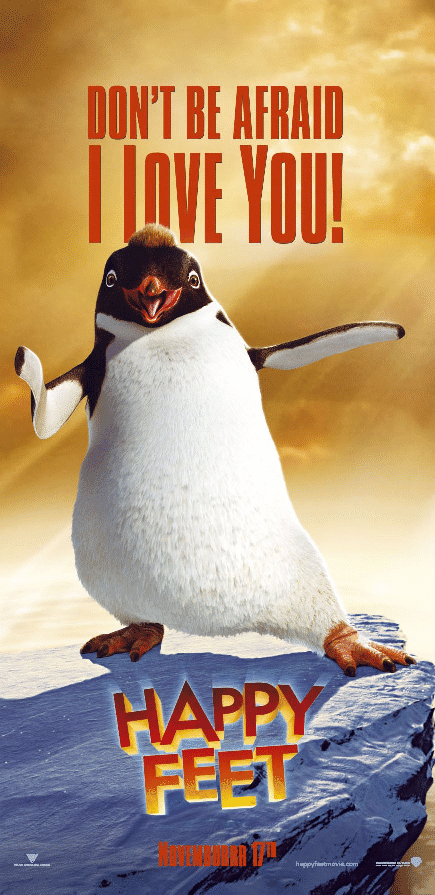
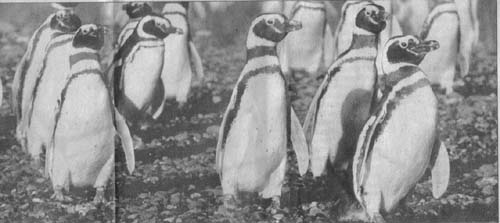
"Happy Feet" puts renewed spotlight on penguinsIf you're ready for a toe-tappin', foot-stompin', knee-slappin', finger-snappin', hand-clappin' good time, waddle on down to the movie theater to see Happy Feet, sort of a snazzier and happier animated version of March of the Penguins. The Emperor Penguins of the Antarctic are the stars of Happy Feet, a movie that- with plenty of tap dancing sequences and cool penguin names like Mumbles and Memphis and Norma Jean- will get you into an anthropomorphic mood. But where, besides a movie theater, can you find these black-tuxedoed birds? Not anywhere north of the Equator, for starters, except in a zoo. They are not in places like the Arctic or Alaska or even Greenland or Iceland or Siberia, all perfectly fine, cold places where you would normally think penguins would hang out. Nope, they're only found near the chilliest of oceans in the Southern Hemisphere. There are 18 species of penguins around the globe, with seven of those species living in the Antarctic, including the Emperor penguin as well as the Adelie, Gentoo and Chinstrap. If Antarctica is just a little too far south and the air just a bit too frosty, then consider South Africa. With direct flights from the United States, South Africa is perhaps the easiest place to get to for seeing penguins. African penguins, like humans, enjoy warm weather in addition to their cold ocean. Boulders Beach, a series of hidden sea coves near Simon's Town on the eastern coast of the Cape Peninsula, and Stoney Point in Betty's bay on the Western Cape are two of the best locations to find them. Others live in the coastal regions of Namibia, which borders South Africa to the north. Penguins Down UnderMore penguin tourism awaits in Australia, where the "Penguin Parade", one of the continent's best known wild-life attractions, is on Philip Island, just outside of Melbourne. This just happens to be the world's largest colony of Little Penguins, with numbers approaching 26,000. Philip Island, just 16 miles long and fewer than 5 miles wide, is also a year-round home to a variety of other species of wildlife, including koalas, seals and hundreds of bird species. Another place to see penguins in the wild is in South America, primarily in the Patagonia Region. Humboldt and Rockhopper Penguins live on the coastal shores of Chile and Peru, while the King Penguin is found primarily in Tierra del Fuego, on the very tip of Argentina. Galapagos IslandsThanks to the chilly waters of the Humboldt Current, another place to see penguins is in the Galapagos Islands. Like the Jackass penguins of South Africa, the Galapagos Penguins, which live close to the Equator, prefer warmer water. The Galapagos Islands, like Philip Island, offer incredible wildlife besides penguins, including whales, giant tortoises and the blue-footed booby. The yellow-eyed penguin is the rarest of all. To see it, you must travel to either Tasmania or New Zealand. The yellow-eyed penguin has distinctive yellow eyes highlighted with a bright yellow stripe that runs around the back of its head. You also can find Little and Fiordland Penguins in New Zealand. Where to Find Penguins |
|
|
|
No one involved in Happy Feet set out to make a block-buster tribute to tap-dancing. But as it turned out, the movie about a hyper-rhythmic penguin who saves his flock with his dancing feet is the best thing to happen to tap since Fred Astaire. Perhaps it's better. Astaire was big, Astaire was a genius, Astaire was Astaire- but he was no darling, fuzzy little bird, nor the object of pint-size wuv. The misfit penguin Mumble, on the other hand, is all these things and one of the biggest stars at the box office. The flightless fowl is sure to be seen by zillions of kids and parents around the globe. For fans of rap, humble Mumble is the new messiah. It's not such a crazy notion. At first blush, Happy Feet may seem to be just another computer-generated kid flick, like Shrek or Toy Story. But in skillfully merging art and entertainment, it sets a new 21st-century standard for the movie musical. Like the great pictures of the '30s, '40s, and '50s that showcased the talents of Astaire and Ginger Rogers, Gene Kelly, Judy Garland and their ilk, Happy Feet tells a good part of its story through the music of its day, incorporating rap, funk, disco, rock and Latin tracks. A few grand multi-penguin production numbers, featuring singing and dancing, flesh out the main characters, mark key emotional segments and move the plot along. But what makes Happy Feet both a throwback to Hollywood's golden era and a product of the digital age is this: It relies on real, live talent for the dancing. For it's not mere pixels that make Mumble move; it's Savion Glover, the onetime whiz kid of tap, who, at 33,is the highest-profile solo artist in the business. Motion-capture technology was used to transfer Glover's performances in a specially equipped studio onto an animated character on-screen. "I knew even the greatest animators in the world would take a lifetime to pull off the nuances of dancing that a gifted dancer is able to pull off," says Happy Feet director George Miller. Admittedly, The Austalian filmmaker is a bit of an odd choice to take up the mantle of Vincent Minnelli and Bob Fosse. He was first a doctor, then a director; he previously helmed in the three Mad Max movies, Lorenzo's Oil and Babe: Pig in the City (sequel to the first Babe film, on which Miller was a writer) "I never, ever thought, until Happy Feet, that I'd work on a musical," Miller says. But music became imperative to his concept of a penguin drama. Miller says he had long been intrigued by the Antarctic's Emperor Penguins- well before last year's documentary March of the Penguins came out, as Happy Feet was four years in production- and by the fact that in their close-knit communities each bird is identified by a signature squawk. Miller envisioned a colony of penguins not squawking but singing, courting their mates with the power of their innate "heartsongs." And what if one hatchling couldn't carry a tune? Maybe he could make music...with his feet. In other words, tap dance. "It's the closest thing to singing with the body that you could do," said Miller. "And I just had this thing about tap-dancing." That "thing" developed some time ago when, while working on another project, a crew member's wife taught Miller a bit of tap-dancing for a cast party. "I had quite a bit of alcohol," he recalls with a laugh. When he knew his film would focus on a tap-dancing penguin, Miller said, he studied the classic movie musicals, drawing on Gene Kelly's finesse, the pacing of West Side Story and even the kaleidoscopic patterns of Esther Williams' films, for the penguins' underwater sequences. Next logical step: Bringing aboard Glover- whom Miller calls "without question the greatest living tap-dancer." It's a difficult point to argue, with his Broadway successes (including Bring in 'da Noise, Bring in 'da Funk, in which he starred and won a Tony for best choreography) and heavily attended one-man shows. The hoofer is a true percussionist, with a heavy-hitting, powerful style that directs all attention to the beat- no flash, little upper-body movement, just two feet drumming out a force field of sound. For Miller, Glover's ultra-contemporary style was a perfect way to amplify Mumble's character. For Mumble stands apart for other reasons besides being tone-deaf. He's blue-eyed and irrepressibly bubbly (brightly voiced by Elijah Wood). The scorn of his elders doesn't get him down. And when he finds that his flock's dwindling food supply is due to "aliens"- humans who are polluting and overfishing their waters- he sets out to stop them. On a certain level, this is so like a tap-dancer. Akin to a jazz improviser, a geat hoofer doesn't follow set steps. Being out of step, in fact, is his strength. He goes his own way, he refuses to conform. His rhythm is intuitive, and with it he generates his own joy. The film has many messages, including environmentalism, the struggle between dogma and daring, and the value of questioning authority. But none of these points were what drew Glover to the production. In fact he says he knew next to nothing about the plot- nor that stars such as Robin Williams, Nicole Kidman and Hugh Jackman were lending their voices- until he attended the premiere. The movie's success has been a big surprise. When Miller first approached him about the tap-dancing penguin idea, "I was just so excited that someone was putting dance in the movie," Glover said. "I didn't ask any questions. I was just going on the strength of tap-dancing- someone wants tap-dancing." Once he flew to Australia, he was fitted with a skintight suit suit covered with small reflectors. Cameras then captured the motion of the reflectors as Glover danced, and technicians applied the data to the image of Mumble. The result could be seen instantly- instead of looking at his reflection in a mirror, the way a dancer might practice in a studio, Glover faced a computer screen as he danced, which showed what he looked like as Mumble. Miller, also peering into a monitor, could speak to Glover through a headset to keep his performance in line with a penguin's range of motion. For instance, Glover needed to starighten his posture- in his own performances, he tends to look down, focusing on his feet, and "that just wasn't a good look for the penguin," the dancer says. Despite the upright stance, for followers of tap, the penguin's footwork is unmistakably Glover. Miller loves the idea that Mumble's "stunt double" is clear to the discerning eye. "People say that pretty soon we can make (computer-generated) actors, but the truth of the matter is you can't deny that life-force in people," he says. "You can feel Savion very clearly in penguin." For his part, Glover feels Miller has done tap a major favor, sparking "a resurgence in the dance, to really help us maintain a presence." |
 |
|
|